For this episode, we’re going to be taking a trip. We’re heading north to the Toronto area, where we’re going to visit with Michael Albanese. He is the author of a water harvesting book called The Modern Rain Garden, Scrape, Shape and Plant, now in its second edition.
Michael has designed and built dozens of rain gardens and also has helped countless others build theirs. He’ll explain what rain gardens are, and what’s behind the scrape, shape, and plant approach to rain garden design and construction.
Transcript
INTRO: From Tucson, Arizona, welcome to the Water Harvesting 101 podcast. My name is Martha Retallick. I’ve been a water harvester for 20 years, and I’m looking forward to helping you get started.
Before we do that, here’s a little Tucson secret: For most of the year, we’re in drought. That’s just how life is in the desert.
But when the rains return, oh, do they ever. They often bring an unwelcome friend called flooding.
How do we reduce the risks of flooding? We do it with water harvesting.
Water harvesting encompasses three activities:
- Redirecting rainwater away from where it isn’t wanted to where it is.
- Storing rainwater for later use, for example, during a drought.
- Recycling “used” water. At my place, I don’t let laundry water go down the drain. Instead, it’s for the fruit trees.
We’ll be covering all of these topics and more, so let’s get started.
EPISODE: For this episode, we’re going to be taking a trip. We’re heading north to the Toronto area where we’re going to visit with Michael Albanese. He is the author of a water harvesting book called The Modern Rain Garden, Scrape, Shape and Plant, now in its second edition.
Michael has designed and built dozens of rain gardens and also has helped countless others build theirs. In this episode, he’ll explain what rain gardens are, and what’s behind the scrape, shape, and plant approach to rain garden design and construction.
Martha: Michael, welcome to the podcast.
Michael: Thanks for having me.
Martha: First of all, let’s talk about the book title. Define what a rain garden is and also talk a little bit about the scrape, shape and plant philosophy.
Michael: Starting with what a rain garden is very broadly, it’s a shallow bowl shaped planted area that’s designed intentionally to manage and absorb rainwater.
The scrape, shape and plant methodology, which is the subtitle of the book summarizes my approach of using existing soil. It’s not an “amend first” approach. It is a “use the native soil first” approach.
The “scrape and shape” focuses on the earthworks portion, which, in my opinion, is just as important as the plants. So it’s scrape, shape, and plant because you need all three of those things for the rain garden to come together.
Martha: To those of you who are listening from the Southwestern United States, if you see a book like this with all sorts of green plants on the cover, the principles are pretty much the same.
But here’s the thing: The basins we dig here, to you, they would look like meteor craters. I have two of them in my front yard.
The first basin looks like it got struck by a meteor and then the meteor bounced and create a second basin, which is the overflow basin. Your basins are a lot more shallow.
Michael: And why would that be? Well, as you alluded to, being in the southwestern United States, the hydrology in that part of the world is very different from my part of the world, right?
I’m up in southern Canada, right in the heart of the Great Lakes Basin in Hamilton, Ontario, where our baseline is much more wet than your baseline. I don’t want to over-saturate the rain garden because, again, the point of the rain garden is not to keep water at the surface, it’s to absorb water into the ground.
This is obviously a broad generalization, but our soils are broadly and generally more biologically active than the very-drought stricken American Southwest.
So, your deep basins are more out of necessity to capture as much water as you can – in soil that is less biologically active than what we have up here in Southern Canada.
Martha: In your book, you talk about two types of water that we’re dealing with in the rain garden world. First of all, there’s rainwater, the stuff that falls from the sky. And then there’s stormwater. How does stormwater figure into all of this?
Michael: They’re kind of two sides of the same coin, right?
I have a colleague who says to me all the time, “I want to get away from using the word ‘stormwater.’”
And he says, “Stormwater is what happens when I don’t do my job.”
So, all stormwater starts as rainwater, right? When it falls from the sky, it’s not yet stormwater.
It hasn’t had time to pick up the pollutants, fertilizers, hydrocarbons, all of the bad things that come with the human built environment.
So, rainwater is kind of like the precursor of stormwater.
What I try to do is manage rainwater on site before it becomes stormwater. Because as soon as it becomes stormwater, you have stormwater and runoff. They kind of go hand in hand.
You have water that’s typically warmer. You also have water that’s typically has more nutrients, more pollutants, less oxygen.
So, we can still clean stormwater, but the best medicine is obviously prevention and absorbing rainwater into the ground, keeping it as healthy as possible at the start. To me, that is how we start to see the most benefits realized from a watershed health perspective.
Martha: And tell us a little bit about your book. What’s it all about? Why people should read it and where can they get it?
Michael: It’s really an account of my personal experience with rain gardens and it breaks down the scrape, shape and plant methodology. So, it’s a combination of the scientific and the technical and the practical and the approachable.
It goes over water in, and water out. It goes over tools. It goes over sizing in terms of both footprint and depth. Just lots of examples, photos of projects that I’ve done.
I’ve been building rain gardens professionally for over 10 years now. So, it’s got a lot of different examples.
I say all the time, I build many rain gardens. I never built the same rain garden twice. They all have their own little intricacies and uniqueness about them.
So it’s really about not trying to tell people how to build one specific rain garden. It’s intended to arm people with knowledge and background information so that they have the confidence building the rain garden that they need.
It’s available on two places. The first one and the easiest way to get it is Amazon. Just put The Modern Rain Garden into the search box and look for the second edition because the first edition is out of print. I don’t believe you can still buy the first edition, but it is still listed on Amazon.
The second place to get it is through my website, AVESIStormwater.com.
Martha: And I want to tell people about this book. This isn’t a book that’s just going to sit on your shelf or your coffee table. It’s going to get you doing things.
I got an idea before I even opened the book. That photo of the flagstone stair steps below the downspout? I want one of those!
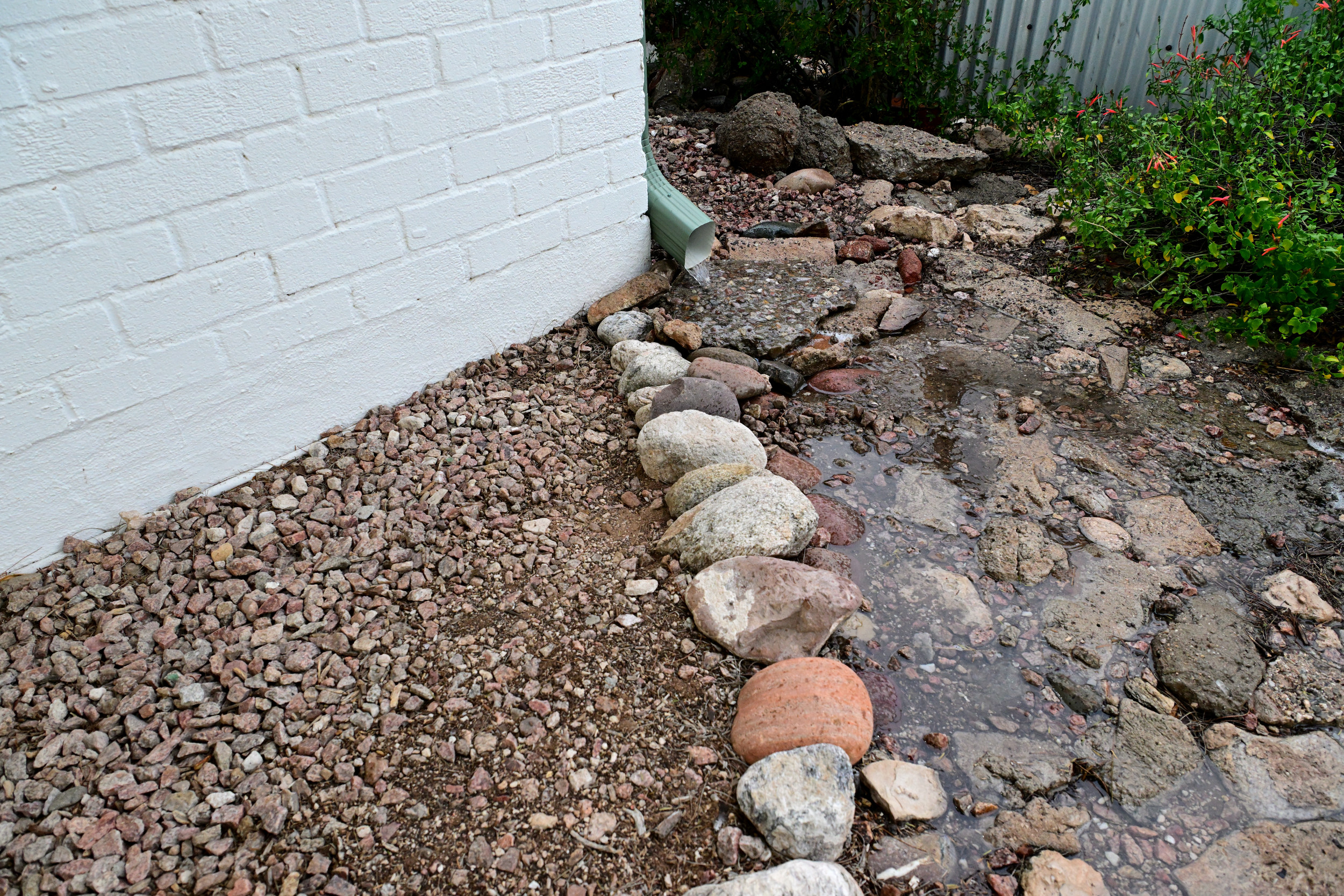
And I’m beginning to build one. I started by building it with flat pieces of cement – or what I thought were flat pieces of cement. [Spoiler alert: They aren’t! See above photo.]
And I put the word out on the neighborhood grapevine: I’m looking for busted up pieces of flagstone.
Haven’t found any yet, but I’m going to be building something like that at the top of my swale to get the water to start flowing downhill away from the house and not spilling off to the sides. It’s allowed to spill out to the sides once it’s actually down in this swale.
But I’ve got to find the flagstone first, and I’m looking for it. So, this is the kind of book it is. It’s going to make you busy.
Michael: Well, I appreciate that. That sounds like a great idea. I love that approach. I call it the cascade.
We have a lot of cascades where I’m from. I’m actually from what we call the City of Waterfalls because we are right on the Niagara Escarpment. So there’s no shortage of inspiration around here to see rockery channels and things like that.
So what you’ll see on the front cover is a little rock cascade that directs water artfully into a rain garden basin that you can’t really quite see in this photo. That’s what those do – they absorb the force of the water and they bring that water down into the infiltration basin, which is the rain garden.
Martha: Any concluding thoughts for our listeners?
Michael: You’ve got to be able to know where the water is going when it’s raining.
So, if you haven’t already, take a look at the weather, plan for the next time there’s going to be some rain, go outside with an umbrella, and bring a flashlight if it’s dark.
Walk around your property and see where the water is flowing. That is where it all starts.
Martha: Thank you very much for joining me on the Water Harvesting 101 Podcast.
Michael: Thanks for having me.
If you’d like to learn more about water harvesting, sign up for my monthly email newsletter. If you do, I’ll give you a free copy of my Water Harvesting Cheat Sheet.
And if you’d like to support the Water Harvesting 101 podcast, the PayPal email address is info@westernskycommunications.com.
OUTRO: Thanks for listening to this episode of the Water Harvesting 101 podcast. If you’d like to learn more about water harvesting, meet my book family.
First, it’s City Nature, the book that’s guaranteed to look great on any coffee table. City Nature reveals my secrets to water harvesting through my 20-year journey of transforming my Tucson home into an urban oasis. Get the details at CityNatureBook.com.
And if you’re on the go, take water harvesting with you. Water Harvesting 101 is an audiobook and eBook combination that will teach you the nuts and bolts of water harvesting and show you how to put them to work. Available exclusively at WaterHarvesting101Book.com.