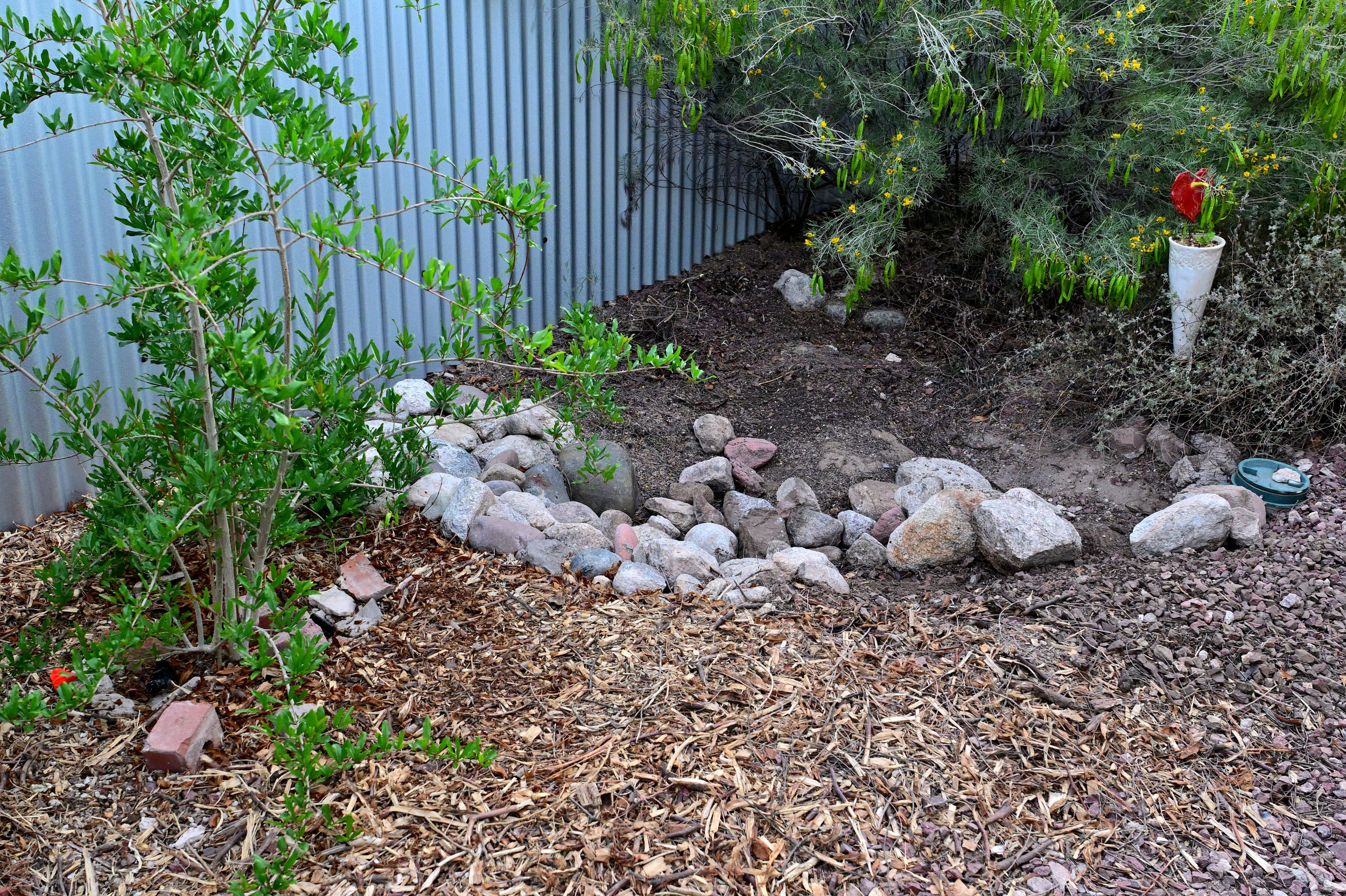
As water harvesters, we use organic and inorganic mulches in our landscapes.
Organic mulches are derived from carbon-based life forms like trees, and you’ll recognize them as bark chips and wood chips.
Inorganic mulches? They’re more commonly known as aggregate or crushed rock.
Which mulch should you use? And where? In this episode, we’re joined by Shota Austin from Tank’s Green Stuff here in Tucson. He’ll tell you everything you need to know about mulch.
Transcript
INTRO: From Tucson, Arizona, welcome to the Water Harvesting 101 podcast. My name is Martha Retallick. I’ve been a water harvester for 20 years, and I’m looking forward to helping you get started.
Before we do that, here’s a little Tucson secret: For most of the year, we’re in drought. That’s just how life is in the desert.
But when the rains return, oh, do they ever. They often bring an unwelcome friend called flooding.
How do we reduce the risks of flooding? We do it with water harvesting.
Water harvesting encompasses three activities:
- Redirecting rainwater away from where it isn’t wanted to where it is.
- Storing rainwater for later use, for example, during a drought.
- Recycling “used” water. At my place, I don’t let laundry water go down the drain. Instead, it’s for the fruit trees.
We’ll be covering all of these topics and more, so let’s get started.
EPISODE: This is an episode about mulch.
In the water harvesting world, we use two types of mulch. First, there is organic mulch, think bark chips or wood chips.
And then there is inorganic mulch, think crushed rock.
Note: Both types are shown in the above photo.
If you are starting a new water harvesting project, you may not have these materials on site, which means you’re going to need to buy them.
Martha: This episode features a company that will sell you both organic and inorganic mulch. The company is Tank’s Green Stuff. It’s located here in Tucson.
And from Tank’s Green Stuff, we have Shota Austin.
First question I have for you is, where can we find Tank’s Green Stuff online? People are going to want to be following along with this podcast and looking at the products.
And tell us how the company got its name.
Shota: Yes, you can find more information about Tank’s Green Stuff at TanksGreenStuff.com.
And, of course Tank’s got its name from its owner. Tank’s Green Stuff is a family owned business run by Jason Tankersley and his sister, Amanda Myers Tankersley.
And so Tank’s comes from Jason Tankersley’s nickname. And that’s why it’s called Tank’s Green Stuff.
The Tankersleys have been running this business since 1986 and operate three recycling and landfill facilities here in Southern Arizona. Jason Tankersley started the organics material division in 2010.
We started composting, making wood chips, mulch, and all kinds of other soil products and landscape materials with the recycled material from our landfill recycling facilities.
Martha: In the water harvesting realm, we refer to such things as wood chips. We call them organic mulch because they come from carbon-based life forms, trees.
Can you tell us a little bit about exactly where the wood chips come from, a little bit more detail? And there’s a certification that I think people would like to know about. I believe it’s called OMRI.
Shota: OMRI certification, that’s our organic certification that we use in our organic compost, our Potting Mix, and our Super Mix fertilizer.
Our wood chips are not technically OMRI certified, but what we do at our facilities is we accept landscape trimmings. We accept basically two different types that we call Mixed Green and Clean Green.
Mixed Green is landscape trimmings with cactus palm, but free of trash and lawn clippings. And that goes into alternative daily cover and biofuel.
We also offer Clean Green, which is landscape trimmings free of cactus, palm, lawn clippings, and trash. And that goes into organic compost.
And then, out of both piles, we pull and sort logs. So, anything we can put hands on and pull out of the pile, or if we have a truckload of limbs and just big logs, then we use those to make our decorative wood chips.
Martha: I want to tell people something about wood chip mulch. If you’re having it delivered, it’s going to come to you in a big truck.
If you’re like me and you have a concrete driveway, when that mulch is delivered, it’s Go Time.
The reason for that is if you leave it in your driveway, it’s going to stain the driveway.
If your property is set up where the truck can back up and put it in your yard, you can take your time about distributing it.
For all the concrete driveway people out there, get ready, get set, it is time to get to work.
You sell wood chip mulch, if you’re delivering it, it’s sold by the ton, correct?
Shota: We sell our wood chips by the cubic yard, both the large and the small sizes. And, of course, customers who are concerned about their driveway can always put down a tarp, and we can do our best to drop the material on the tarp.
A good rule of thumb is that two people with five-gallon buckets can move a yard of material in about 30 minutes.
Martha: I wish I had a tarp.
I just have to use the Go Time system. Start filling those buckets and get that stuff out in the yard.
Shota: Right. You might as well get it done.
Martha: Yes, you might as well get it done. Exactly right.
The organic mulch works best in places where the water flow gently comes in. The water soaks into the ground.
Then there’s inorganic mulch, as in, crushed rock. We like that in places where the water flow is rapid like, for example, in a street-side water harvesting basin.
You want material on the bottom of that that’s going to stay put. So that’s where the crushed rock comes in.
In your business, it’s called aggregate. Tell us a little bit, let’s see, my favorite is called Track Out 1”-3”, which sells for $36 a ton.
Tell us about how that gets delivered and where that comes from.
That is a product that we make at our Wilmot facility, where we operate a landfill recycling facility. And as we’re digging up the landfill, we’re crushing and screening the rock to make products for Southern Arizona.
And so that Track Out 1”-3” is made of screened and crushed rock and will be delivered in a dump truck.
Obviously, it’s quite heavy. The easiest way is just to have it delivered in a dump truck.
You could also go with something like the 57 Rock. The 57 Rock is like a 1” to 1.75” size rock that is used for typically for like sewer systems and water infiltration systems. That could also be an option if you’re looking for something in a smaller size.
Martha: And remember, people, these rocks go in the bottom of your basin.
As a general rule, we line the sides of basins with big rocks because the sides of the basins are steep and we’re trying to prevent erosion.
If you’re digging a basin anywhere in Tucson, guaranteed, you’re going to find those big rocks. This is a very rocky place.
Shota: It is.
Martha: You also mentioned socks. Tell us about socks.
Shota: Erosion Control Socks are something else that we offer. We take offer a heavy-duty sock as well as a biodegradable sock.
We can fill them with wood chips or a combination of wood chips and compost or biochar.
We recommend those for rainwater harvesting in areas where you might not want to have something permanent.
Let’s say you’re testing your design and your design philosophy. Then erosion control socks are a nice easy way to lay down some pathways or some berms to move water in a certain direction.
Or let’s say that monsoon season is around the corner and you’re worried about high flow or you’re trying to pull silt out of the water before it hits your rainwater harvesting basin. Those are some of the applications for the erosion control socks. We offer them in 8” and 12” sizes and at custom lengths per order.
Martha: You mentioned something very important and that is testing your design. At first you’re going to build this and think, this looks great.
And let’s say, right now at this time of the year, it’s starting to dry out. Although there are rumors that we could have a good monsoon season this year, we don’t know. You need to see how your design performs under actual rainstorm conditions.
If you’re setting up this system for water harvesting, using passive water harvesting features like berms, basins, and swales, it may be a few months before you can actually see how it works.
Shota: The erosion control socks are great because you can use them to stabilize really steep hills. You can also use the biodegradable sock in conjunction with plantings or seed.
So, long term, you’re not going to be picking up that sock, but creating an organic berm or organic swale using the sock and some plants.
Martha: This is quite a diversified company. You also offer those great big roll offs.
So, if you’re doing a demolition or you’re pruning a lot of plants, and you need some place to throw them, and your City of Tucson can isn’t big enough, Tank’s provides big green roll-offs. Very well recognized in Tucson.
Shota: When they bring you the roll-off, they can also deliver wood chips or the 57 Rock at the same time. So you don’t have to pay for a delivery fee for the material.
Martha: And I notice also Tank’s Recycling.
Shota: That’s where we got our start, through recycling. That’s where the organic division came to be. We’re just trying to find a way to keep organic material out of our landfills.
Martha: And thank you for doing that. We appreciate it.
Shota: Yeah, no problem.
Martha: Again, the website is TanksGreenStuff.com. And thank you very much – Shota Austin from Tank’s Green Stuff here in Tucson.
If you’d like to learn more about water harvesting, sign up for my monthly email newsletter. If you do, I’ll give you a free copy of my Water Harvesting Cheat Sheet.
And if you’d like to support the Water Harvesting 101 podcast, the PayPal email address is info@westernskycommunications.com.
OUTRO: Thanks for listening to this episode of the Water Harvesting 101 podcast. If you’d like to learn more about water harvesting, meet my book family.
First, it’s City Nature, the book that’s guaranteed to look great on any coffee table. City Nature reveals my secrets to water harvesting through my 20-year journey of transforming my Tucson home into an urban oasis. Get the details at CityNatureBook.com.
Water Harvesting 101 Podcast: Episode 51 – The Mulch Episode↗ is now live.
What’s next?
Post address
And if you’re on the go, take water harvesting with you. Water Harvesting 101 is an audiobook and eBook combination that will teach you the nuts and bolts of water harvesting and show you how to put them to work. Available exclusively at WaterHarvesting101Book.com.