Tucson just played host to a heat wave.
As in, triple-digit temperatures. In March.
This episode provides practical tips for coping with such an event, whether it’s in March or at other times of the year. You’ll learn how to handle your gardening and your household.
Transcript
INTRO: From Tucson, Arizona, welcome to the Water Harvesting 101 podcast. My name is Martha Retallick. I’ve been a water harvester for 20 years, and I’m looking forward to helping you get started.
Before we do that, here’s a little Tucson secret: For most of the year, we’re in drought. That’s just how life is in the desert.
But when the rains return, oh, do they ever. They often bring an unwelcome friend called flooding.
How do we reduce the risks of flooding? We do it with water harvesting.
Water harvesting encompasses three activities:
- Redirecting rainwater away from where it isn’t wanted to where it is.
- Storing rainwater for later use, for example, during a drought.
- Recycling “used” water. At my place, I don’t let laundry water go down the drain. Instead, it’s for the fruit trees.
We’ll be covering all of these topics and more, so let’s get started.
EPISODE: Here in Tucson, we have been having a heat wave.
As in, temperatures of 100 degrees or more. In March.
The good news is the worst of the heat wave is over. We’re now down to highs in the 90s, and next week, there is a possibility of even cooler temperatures with R-AI-N. That’s the forecast.
In this episode, I’m going to talk about handling a heat wave as a water harvester.
The first piece of advice I’d like to give you is that this is not a good time of the year to be digging holes in the ground, planting things in them, sowing seeds, or trimming your trees and shrubs.
However, on the trimming rule, there is one exception. If you have a citrus tree, take a good look at it right now.
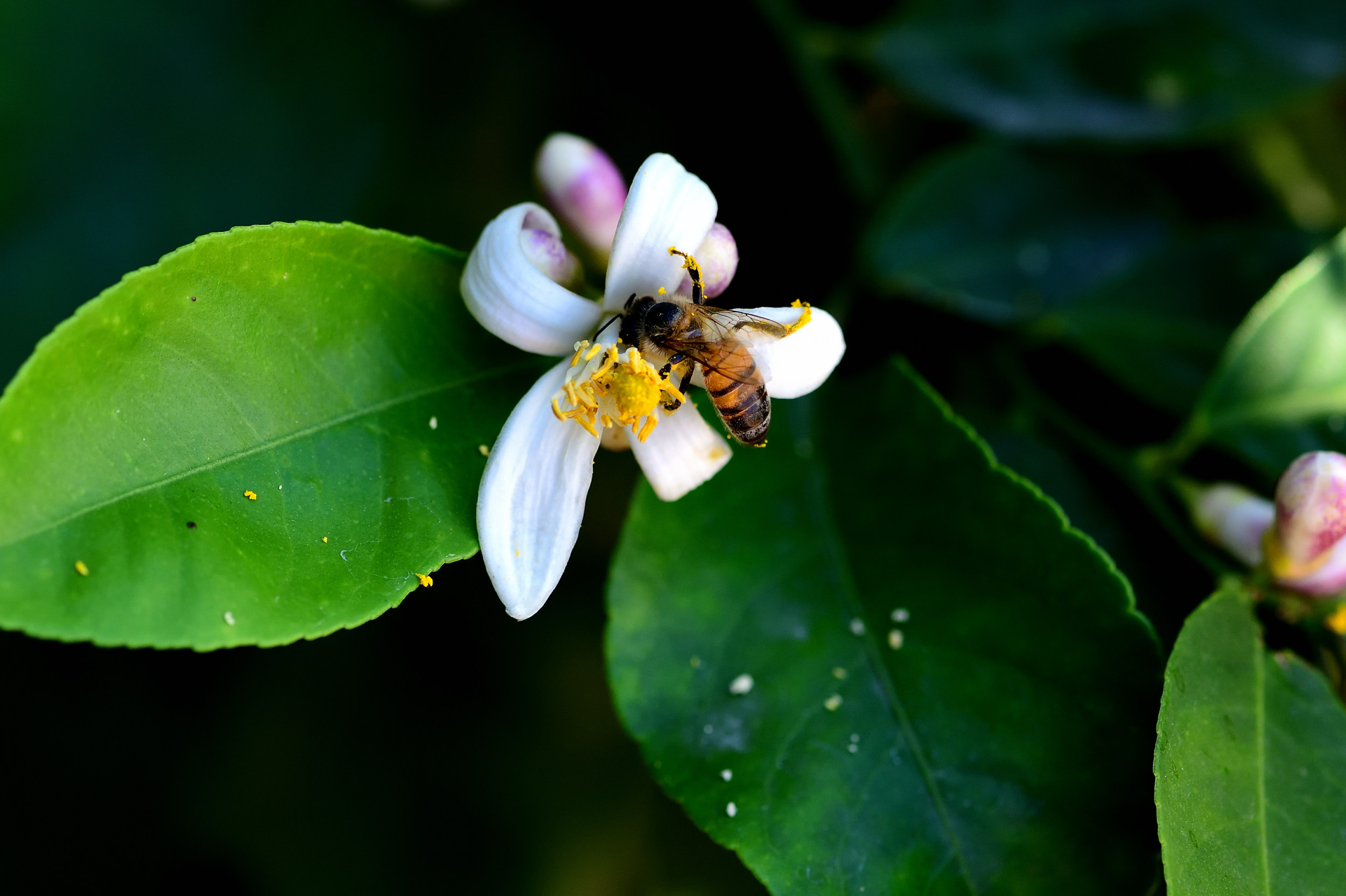
You’ll probably notice a lot of flowers with very busy bees! They’re pollinating like crazy – like the one in the photo above!
You may also notice some of the branches have no flowers , and they’re growing very rapidly. Those are called suckers, and they produce nothing.
What to do with suckers? Cut them off the tree!
I say this because suckers take energy away from the rest of the plant. During a drought – and at other times of the year – your citrus tree needs to direct its energy toward growing branches that produce fruit. So, don’t be afraid to cut the suckers off – even during a heat wave.
Another thing about heat waves, and this is advice for all the humans out there: At this time of the year, triple digit temperatures are not typical. You’re not used to the heat yet
So, don’t go out there at three o’clock in the afternoon and do heavy yard work unless you absolutely have to. Otherwise, just stay in the house.
You may need to shift activities to earlier in the day, like, take for example, I’m recording this podcast before 6 a.m. Reason: This is the time of day when the air conditioner won’t be running.
I keep my thermostat set to 80 degrees, and it’s in the low 70s right now. I have doors and windows open to allow the cool air to come in the house before later in the day, when the air conditioner kicks in. I want to delay that as long as possible.
As for my water situation, I still have plenty of cistern water. I’m using it to water what’s left of my fall/winter garden.
Before the heat wave rolled in, I harvested everything that was leafy, as in lettuce and greens like kale and mustard. The only things left are the snow peas, carrots, radish, and a bit of garlic.
And I want to say something about the garlic. The first three vegetables I mentioned, the snow peas, carrots, and radish. They’re coming out fairly soon.
Garlic? I usually I don’t harvest it until sometime late April or May.
For the summertime, I am looking at seeding melons, okra, and cucumbers. However, even with the heat wave, this is not the time.
Wait till mid-April, even through mid-May and into the summer, before you plant those seeds.
The reason? At night, it still gets cool enough to require a sweater if you’re a human. If you’re a plant, the soil temperature is too cold for your seeds to germinate. So, just wait.
And that’s it on the heat wave front. It is abating.
People, we are going to go back to having a normal spring very soon.
Hang in there!
If you’d like to learn more about water harvesting, sign up for my monthly email newsletter. If you do, I’ll give you a free copy of my Water Harvesting Cheat Sheet.
And if you’d like to support the Water Harvesting 101 podcast, the PayPal email address is info@westernskycommunications.com.
OUTRO: Thanks for listening to this episode of the Water Harvesting 101 podcast. If you’d like to learn more about water harvesting, meet my book family.
First, it’s City Nature, the book that’s guaranteed to look great on any coffee table. City Nature reveals my secrets to water harvesting through my 20-year journey of transforming my Tucson home into an urban oasis. Get the details at CityNatureBook.com.
And if you’re on the go, take water harvesting with you. Water Harvesting 101 is an audiobook and eBook combination that will teach you the nuts and bolts of water harvesting and show you how to put them to work. Available exclusively at WaterHarvesting101Book.com.