Our friends at the National Weather Services’s Climate Prediction Center just released the summer forecast for the American Southwest.
Arizona is in the “above normal” category for summer rainfall, and that’s good news. It points to a possible return of El Niño, a weather pattern that is associated with abundant rainfall.
This episode describes my activities in the here-and-now, along with some summer preparations.
Transcript
INTRO: From Tucson, Arizona, welcome to the Water Harvesting 101 podcast. My name is Martha Retallick. I’ve been a water harvester for 20 years, and I’m looking forward to helping you get started.
Before we do that, here’s a little Tucson secret: For most of the year, we’re in drought. That’s just how life is in the desert.
But when the rains return, oh, do they ever. They often bring an unwelcome friend called flooding.
How do we reduce the risks of flooding? We do it with water harvesting.
Water harvesting encompasses three activities:
- Redirecting rainwater away from where it isn’t wanted to where it is.
- Storing rainwater for later use, for example, during a drought.
- Recycling “used” water. At my place, I don’t let laundry water go down the drain. Instead, it’s for the fruit trees.
We’ll be covering all of these topics and more, so let’s get started.
EPISODE: I’d like to talk about the potentially good news that was just released by the Climate Prediction Center: The state of Arizona is predicted to have above average rainfall for the upcoming monsoon season.
The larger story is El Niño may very well be returning to the American Southwest.
El Niño is a weather pattern that often leads to above average rainfall.
We have been in a La Niña pattern since late last fall and into the winter, and that tends to lead to above average temperatures and below average rainfall.
So, El Nino, you are more than welcome to come visit us this summer.
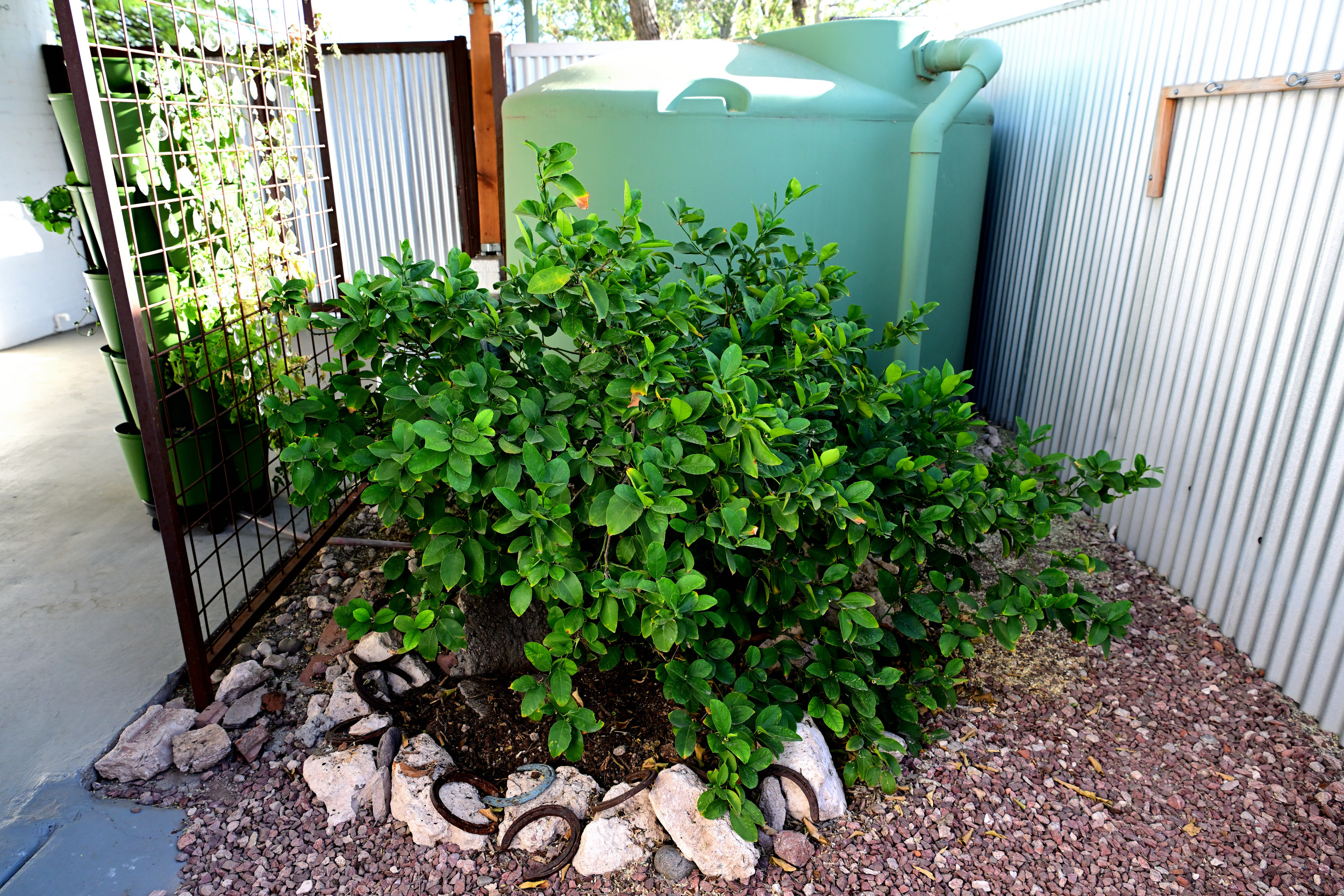
As a water harvester, I’m looking forward to planting melons, okra, and cucumbers for the summer. I have 1,300 gallons of water in my cistern (shown in the above photo, behind the lemon tree), and it holds 1,500 gallons. So, I’m in good shape.
This does not mean that it’s a good time to go crazy with the cistern water and water anything and everything and, oh, water it some more.
It’s a good time to be frugal because even though we are predicted to have above average rainfall this summer, well, It’s April. And April, May, and June are our driest months.
So, it’s a good idea to keep a careful eye toward the sky and monitor your cistern water carefully. You don’t want to drain that cistern dry.
And then, oh no! The rain’s not coming and I’ve got all these plants to water!
You can always go to tap water and use it to water your plants. But let me tell you something: Our water utility, Tucson Water, is very good about telling us how to conserve water.
But if you’re going crazy and watering like crazy, they are more than happy to send you
a bill.
So, be optimistic about the long-term forecast, but also be realistic.
It could be a very long, hot three months. and you’re trying to get those spring and summer seedlings going. That may take quite a bit of water.
You can also help your vegetable gardens, and, possibly, your fruit trees with shade cloths.
I have my shade cloths at the ready in the tool shed. I’m about to bring them out and install them above my garden beds.
I have a new tree, a Fignomenal fig tree in a planter. I may get a shade cloth for it too.
So far, the Fignomenal is not indicating that it needs extra shade. But the summer is coming. Gotta be prepared.
If you’d like to learn more about water harvesting, sign up for my monthly email newsletter. If you do, I’ll give you a free copy of my Water Harvesting Cheat Sheet.
And if you’d like to support the Water Harvesting 101 podcast, the PayPal email address is info@westernskycommunications.com.
OUTRO: Thanks for listening to this episode of the Water Harvesting 101 podcast. If you’d like to learn more about water harvesting, meet my book family.
First, it’s City Nature, the book that’s guaranteed to look great on any coffee table. City Nature reveals my secrets to water harvesting through my 20-year journey of transforming my Tucson home into an urban oasis. Get the details at CityNatureBook.com.
And if you’re on the go, take water harvesting with you. Water Harvesting 101 is an audiobook and eBook combination that will teach you the nuts and bolts of water harvesting and show you how to put them to work. Available exclusively at WaterHarvesting101Book.com.