Ready to take your water conservation efforts to the next level? This episode is for you!
It starts with a plug for landscaping with the drought-tolerant native plants that have been surviving and thriving in the Southwest for thousands of years.
It then moves into a more extreme measure – dispensing with irrigation systems that are tied to a municipal water supply.
Rainwater storage and laundry water recycling are also featured.
Transcript
INTRO: From Tucson, Arizona, welcome to the Water Harvesting 101 podcast. My name is Martha Retallick. I’ve been a water harvester for 20 years, and I’m looking forward to helping you get started.
Before we do that, here’s a little Tucson secret: For most of the year, we’re in drought. That’s just how life is in the desert.
But when the rains return, oh, do they ever. They often bring an unwelcome friend called flooding.
How do we reduce the risks of flooding? We do it with water harvesting.
Water harvesting encompasses three activities:
- Redirecting rainwater away from where it isn’t wanted to where it is.
- Storing rainwater for later use, for example, during a drought.
- Recycling “used” water. At my place, I don’t let laundry water go down the drain. Instead, it’s for the fruit trees.
We’ll be covering all of these topics and more, so let’s get started.
EPISODE: Newsflash! Water harvesting is becoming trendy!
I say this because I’m noticing an increase in media inquiries about water harvesting.
One of the recent ones went like this: Looking for insights about actionable ideas for conserving water while maintaining a home landscape, other than using a rain barrel.
Here was my response, and it may have been a bit more extreme than what they were looking for, but here goes…
Suggestion #1: Start at the landscape planning stage. Build your plant palette with drought-tolerant native plants like we do in the Southwest.
In this part of the world, drought is the default state. Our rain events are infrequent at best. We need plants that know how to survive. Native plants have been doing this for thousands of years.
Suggestion #2: I’m going to get even more radical here. Forget about irrigation that relies on the municipal water supply. In other words, an irrigation system. It turns on and good old potable water comes out.
The reason I say this is because here in the Southwest, we are facing more federal cutbacks in the water that comes to us via the Colorado River and aqueducts like the Central Arizona Project, aka CAP.
What does this mean? It means that CAP water is about to get more expensive. Be a good time to use less of it.
The good news is that it is possible to have a landscape that doesn’t need to be irrigated. I have one!
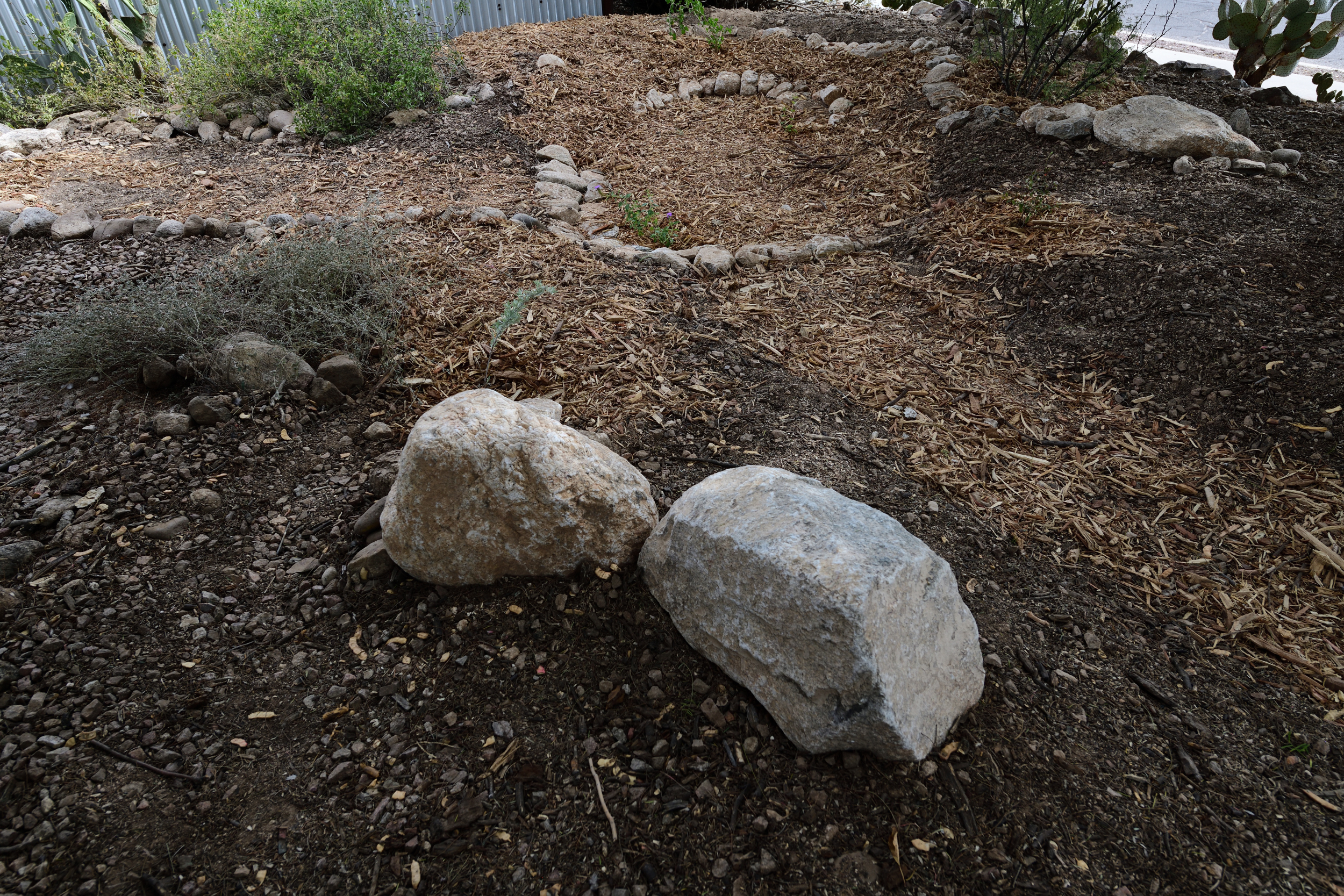
My plants in the front yard (see above photo) and the backyard live off of rainwater, and my landscape doesn’t consist of that stereotypical southwestern landscape with rocks, gravel, and cactus. That is way too depressing.
Instead, my landscape has trees, shrubs, and, yes, some cactus. This is Arizona, after all. And these plants can live off rainwater, even in Tucson, Arizona.
The original request referenced rain barrels. I personally don’t have one because rain barrels just don’t collect enough water for what I’m trying to do.
I use my 1,500-gallon cistern for watering my raised bed gardens. I have two of them. Square footage? About 40 to 45 square feet.
And you may think, oh, 1,500 gallons, that’s a lot. Actually, it isn’t, and that’s why I’m letting the garden lay fallow right now. When the monsoon season returns, I will most likely have the garden planted by then.
Another thought about irrigation: I do have irrigation here. It’s called laundry-to-landscape graywater harvesting. It diverts laundry water away from the sewer system and sends it out to my three fruit trees – two pomegranates and one Meyer lemon.
I have a fourth fruit tree. That’s a Fignomenal fig tree. I take watering cans to it because it’s in a tall planter. There’s no way greywater could be pumped up there from the washing machine. I use cistern water instead, and that Fignomenal is just loving the cistern.
And don’t tell the birds, but that tree just sprouted its very first fig.
So, that’s a look at, well, let’s call it extreme water conservation in the Southwest.
And that’ll do it for this week’s episode of the Water Harvesting 101 podcast.
If you’d like to learn more about water harvesting, sign up for my monthly email newsletter. If you do, I’ll give you a free copy of my Water Harvesting Cheat Sheet.
And if you’d like to support the Water Harvesting 101 podcast, the PayPal email address is info@westernskycommunications.com.
OUTRO: Thanks for listening to this episode of the Water Harvesting 101 podcast. If you’d like to learn more about water harvesting, meet my book family.
First, it’s City Nature, the book that’s guaranteed to look great on any coffee table. City Nature reveals my secrets to water harvesting through my 20-year journey of transforming my Tucson home into an urban oasis. Get the details at CityNatureBook.com.
And if you’re on the go, take water harvesting with you. Water Harvesting 101 is an audiobook and eBook combination that will teach you the nuts and bolts of water harvesting and show you how to put them to work. Available exclusively at WaterHarvesting101Book.com.