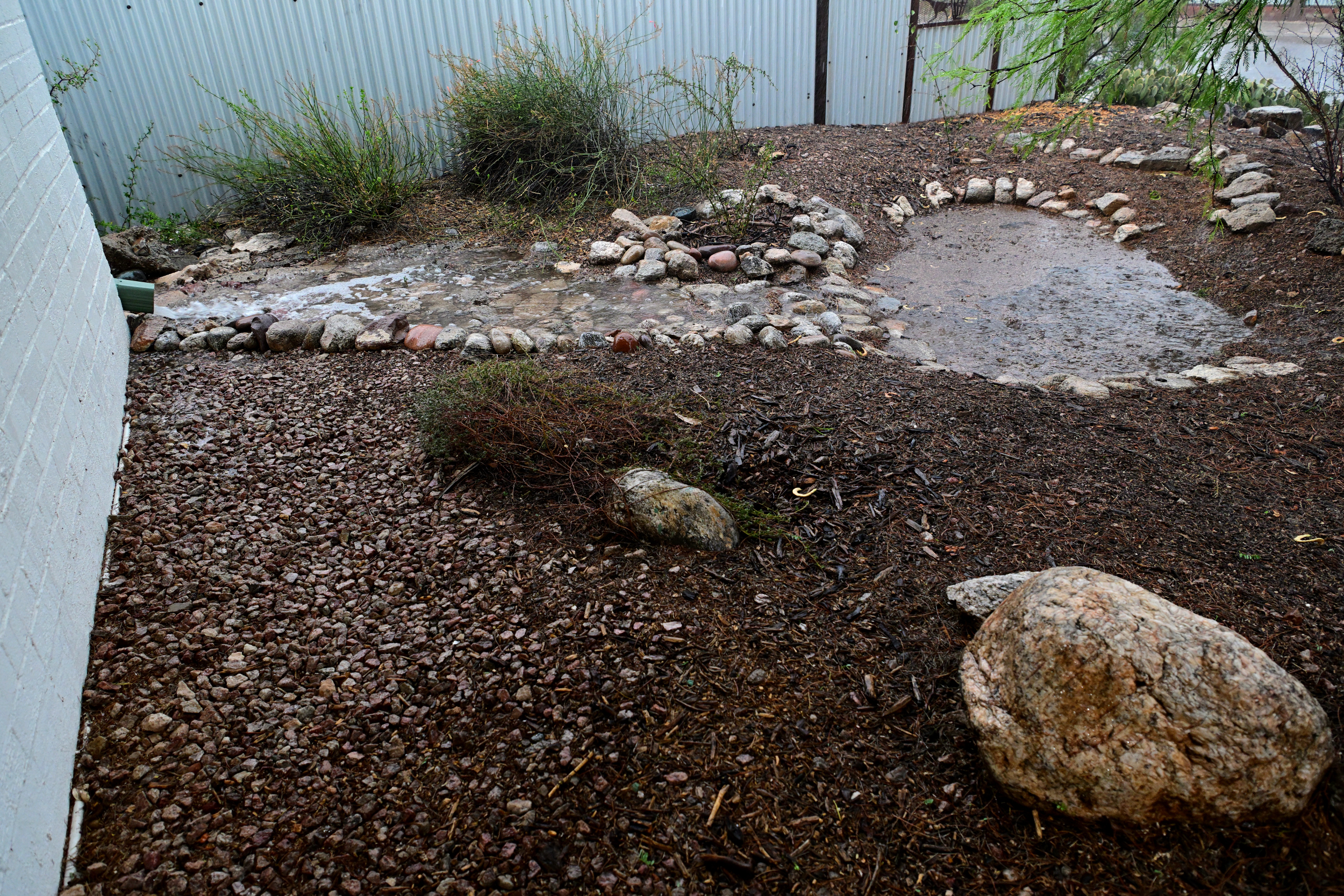
At last!The monsoon rainstorms are here!
Perfect time for a closer look at Water Harvesting Activity #1, Redirecting Rainwater away from where you don’t want it to where you do.
Monsoon season provides a great opportunity for building – and testing – your water harvesting earthworks. These consist of swales, basins, and berms.
Transcript
INTRO: From Tucson, Arizona, welcome to the Water Harvesting 101 podcast. My name is Martha Retallick. I’ve been a water harvester for 20 years, and I’m looking forward to helping you get started.
Before we do that, here’s a little Tucson secret: For most of the year, we’re in drought. That’s just how life is in the desert.
But when the rains return, oh, do they ever. They often bring an unwelcome friend called flooding.
How do we reduce the risks of flooding? We do it with water harvesting.
Water harvesting encompasses three activities:
- Redirecting rainwater away from where it isn’t wanted to where it is.
- Storing rainwater for later use, for example, during a drought.
- Recycling “used” water. At my place, I don’t let laundry water go down the drain. Instead, it’s for the fruit trees.
We’ll be covering all of these topics and more, so let’s get started.
EPISODE: Had to happen sometime!
[sound of rain and thunder]
The monsoon season is in full swing. So, let’s talk about rainwater harvesting during the monsoon season.
Let’s start with with Water Harvesting Activity #1, Redirecting Rainwater away from where you don’t want it to where you do.
Most important, you wouldn’t want rainwater inside your house. I don’t know about you, but I sure don’t want to go canoeing in the living room!
Nor do you want your rainwater to pool near your foundation. That can weaken your foundation.
As rainwater harvesters, we’re going to move that rainfall out into the yard by using water harvesting earthworks that consist of swales, basins, and berms.
What gets the water off the roof and into the swale? Rain gutters that are tied to downspouts that end at swales, and these swales lead to basins. The berms act as earthen dams to keep the water on our properties, and out of the street, where it can become runoff.
If you don’t have these earthworks in place, now is a great time to build them. And this involves digging.
Before you actually dig anything, please call 811, the free utility locator service. You don’t want to find your underground utilities by accident.
One of the easiest ways to build water harvesting earthworks is to let the rain help you.
For example, I’m building a little swale west of my driveway. It’s just south of a downspout that’s been blowing water out into the driveway.
I don’t want it to do that because once water flows down the driveway, it leaves this property and becomes runoff that can cause floods.
So, I’ve been using a rake to scratch a little swale in the dirt. Yesterday we had .63”of rain. And the rain did a much better job of defining the swale path than I did.
Here’s the thing about swales: I recommend that you build them over time. Let the rain help you – and it is more than willing to do right now.
Then when you’re sure that you have this swale where you want it to be – and that it is redirecting rainwater away from where you don’t want it to where you do – then go get some rocks, busted up concrete, bricks, logs, et cetera, and line your swale with them.
These objects serve as bumpers. They slow the rain down so it doesn’t become a rushing torrent across your yard.
Slowing the rain down encourages it to percolate into the ground where it can nourish plants on the way down to the water table.
It’s the same principle behind a basin. A basin isn’t there to be a big swimming pool. It’s there to act as a resting place for your water as it soaks gently into the ground.
If you’d like to learn more about water harvesting, sign up for my monthly email newsletter. If you do, I’ll give you a free copy of my Water Harvesting Cheat Sheet.
And if you’d like to support the Water Harvesting 101 podcast, the PayPal email address is info@westernskycommunications.com.
OUTRO: Thanks for listening to this episode of the Water Harvesting 101 podcast. If you’d like to learn more about water harvesting, meet my book family.
First, it’s City Nature, the book that’s guaranteed to look great on any coffee table. City Nature reveals my secrets to water harvesting through my 20-year journey of transforming my Tucson home into an urban oasis. Get the details at CityNatureBook.com.
And if you’re on the go, take water harvesting with you. Water Harvesting 101 is an audiobook and eBook combination that will teach you the nuts and bolts of water harvesting and show you how to put them to work. Available exclusively at WaterHarvesting101Book.com.