In Tucson, we just experienced our first Freeze Warning of the winter. So, it was time to harvest the Meyer lemons. Here’s a look at how I did that –and what I’m planning to do with my harvest.
Transcript
INTRO: From Tucson, Arizona, welcome to the Water Harvesting 101 podcast. My name is Martha Retallick. I’ve been a water harvester for 20 years, and I’m looking forward to helping you get started.
Before we do that, here’s a little Tucson secret: For most of the year, we’re in drought. That’s just how life is in the desert.
But when the rains return, oh, do they ever. They often bring an unwelcome friend called flooding.
How do we reduce the risks of flooding? We do it with water harvesting.
Water harvesting encompasses three activities:
- Redirecting rainwater away from where it isn’t wanted to where it is.
- Storing rainwater for later use, for example, during a drought.
- Recycling “used” water. At my place, I don’t let laundry water go down the drain. Instead, it’s for the fruit trees.
We’ll be covering all of these topics and more, so let’s get started.
EPISODE: This episode is dedicated to my Meyer lemon tree, which has an important announcement:
This year’s fruit yield is 40 lemons.
It’s well below what I harvested in the early part of 2025 when I pulled 60 lemons off the tree. But last year was a drought year, so there weren’t that many lemon flowers to develop into fruit.
That being said, I’m very happy to harvest 40 lemons.
The reason I harvested the lemons is because late last week, we had a freeze warning. And if you’re a citrus farmer, even if you just have one tree, unless your fruit is not ripe and you’re willing to cover it or maybe put Christmas lights on it to keep it going, it’s time to harvest.
So I grabbed the buckets and gardening gloves.
It’s very important to wear gardening gloves when you’re harvesting citrus because those trees do have thorns and they’re sharp. Don’t ask me how I know that.
I carried a pair of pruners for the fruit that was really stubborn about coming off the tree. And I harvested 40 lemons.
Now they’re in the house and they’re awaiting their next assignment.
Up next, I’m going to juice the lemons. Then that leaves the question of, what am I going to do with all those rinds?
Well, I have a Vitamix blender. It’s like an industrial strength blender.
I can throw the rinds in there, grind them up with water. And then I’ve got a nice lemon rind slurry.
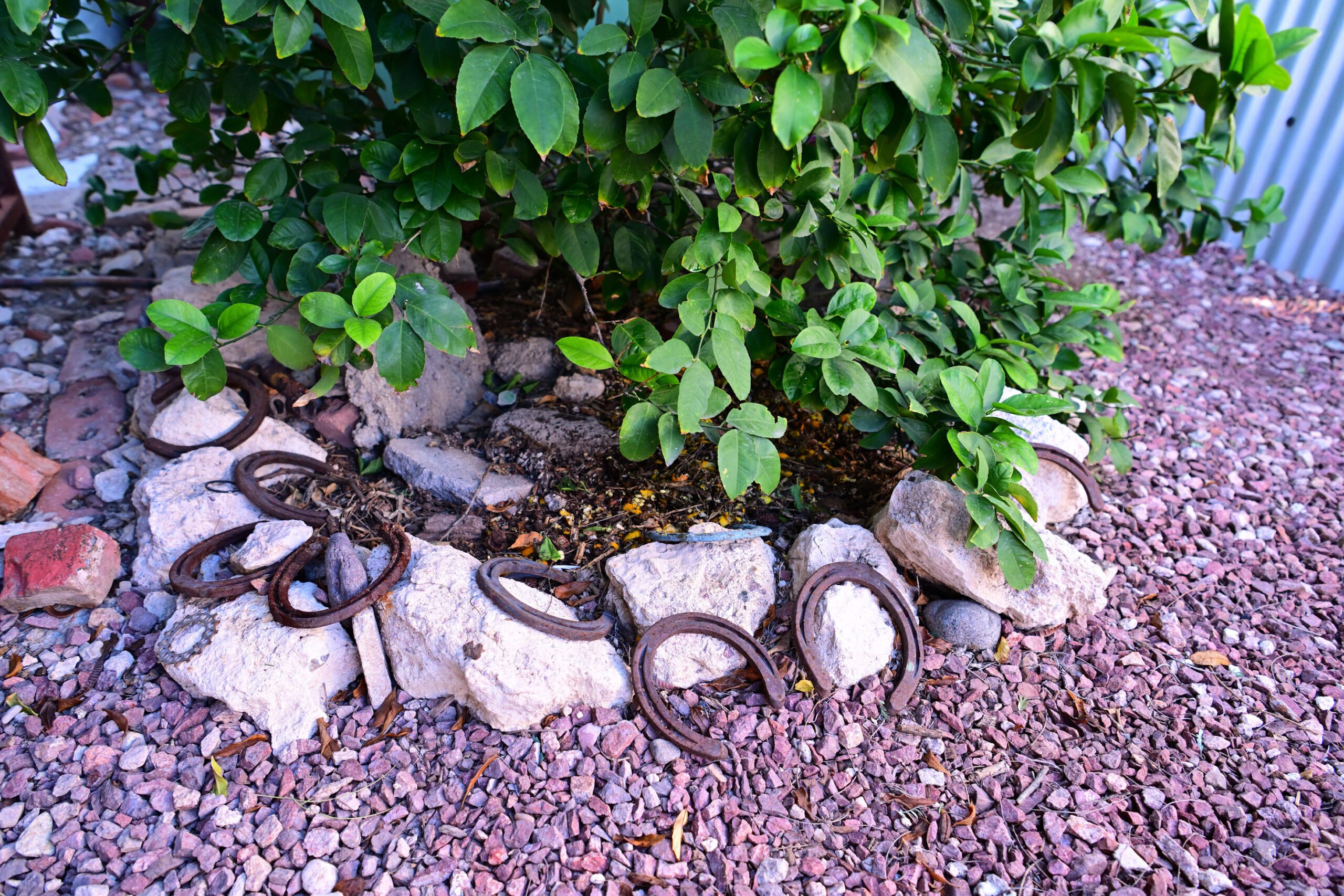
And I’m going to put that slurry around the base of the lemon tree in its little basin. (See above photo, which shows slurry raked into the soil.)
The reason for that is we have very alkaline soil in the Southwestern United States. Putting this slurry around the base of the lemon tree will help to acidify the soil.
Since it’s mid-January right now, I’m not going to be fertilizing this tree for another couple of months.
I use the “four times a year” system. I fertilize on St. Patrick’s Day, Tax Day, which in the United States is on April 15th, Memorial Day, the last Monday in May, and then again on Labor Day, first Monday in September.
And that’s a pretty good boost of nutrition for the citrus trees.
Citrus trees, let’s say they’re emotionally needy trees. You have to fertilize them. You need to give them plenty of water.
And, at my place, I use a laundry-to-landscape greywater harvesting system, which takes water from the washing machine out of the county sewer system. Instead, it gets recycled onto the three fruit trees that are on this system – two pomegranates and the lemon.
Right now the irrigation system is shut off because we’ve had good rainfall this winter so far this month of January 2026, nine tenths of an inch of rain, which means for the annual total for Tucson, we are ahead of schedule.
This is excellent news for this part of the country because we’ve been in a drought for so long.
And I also read recently online a news report about California. There isn’t a single square inch of California that is officially in drought right now.
So, that’s good news for the West Coast. Let’s see what we can do about thinking positive thoughts to bring that news our way.
That’s a look at the harvest report here at my place. I don’t have any other midwinter harvesting to do right now other than lettuce and greens from the garden for salads and greens for cooking.
If you’d like to learn more about water harvesting, sign up for my monthly email newsletter. If you do, I’ll give you a free copy of my Water Harvesting Cheat Sheet.
And if you’d like to support the Water Harvesting 101 podcast, the PayPal email address is info@westernskycommunications.com.
OUTRO: Thanks for listening to this episode of the Water Harvesting 101 podcast. If you’d like to learn more about water harvesting, meet my book family.
First, it’s City Nature, the book that’s guaranteed to look great on any coffee table. City Nature reveals my secrets to water harvesting through my 20-year journey of transforming my Tucson home into an urban oasis. Get the details at CityNatureBook.com.
And if you’re on the go, take water harvesting with you. Water Harvesting 101 is an audiobook and eBook combination that will teach you the nuts and bolts of water harvesting and show you how to put them to work. Available exclusively at WaterHarvesting101Book.com.