Back in Episode 59, I announced that I was a gambler, a garden gambler. I planted a pre-monsoon summer garden.
Now it’s time for an update. It’s a combination of gardening successes and failures, along with some much-needed problem solving and no monsoon rainfall – yet.
Transcript
INTRO: From Tucson, Arizona, welcome to the Water Harvesting 101 podcast. My name is Martha Retallick. I’ve been a water harvester for 20 years, and I’m looking forward to helping you get started.
Before we do that, here’s a little Tucson secret: For most of the year, we’re in drought. That’s just how life is in the desert.
But when the rains return, oh, do they ever. They often bring an unwelcome friend called flooding.
How do we reduce the risks of flooding? We do it with water harvesting.
Water harvesting encompasses three activities:
- Redirecting rainwater away from where it isn’t wanted to where it is.
- Storing rainwater for later use, for example, during a drought.
- Recycling “used” water. At my place, I don’t let laundry water go down the drain. Instead, it’s for the fruit trees.
We’ll be covering all of these topics and more, so let’s get started.
EPISODE: Back in Episode 59, I talked about how I was a gambler, a garden gambler.
The reason I said that is because I decided to plant a summer garden here in Tucson, Arizona. And yes, the triple digit temperatures are here.
So, how’s the garden doing?
I planted a total of 33 square feet of raised bed garden space for the summer. I’ve already had to call it quits on my little garden bed because I planted seeds, planted seeds, watered them, watered them, and watered them.
They didn’t germinate.
So, that took six square feet out of production. I’m down to 27 square feet.
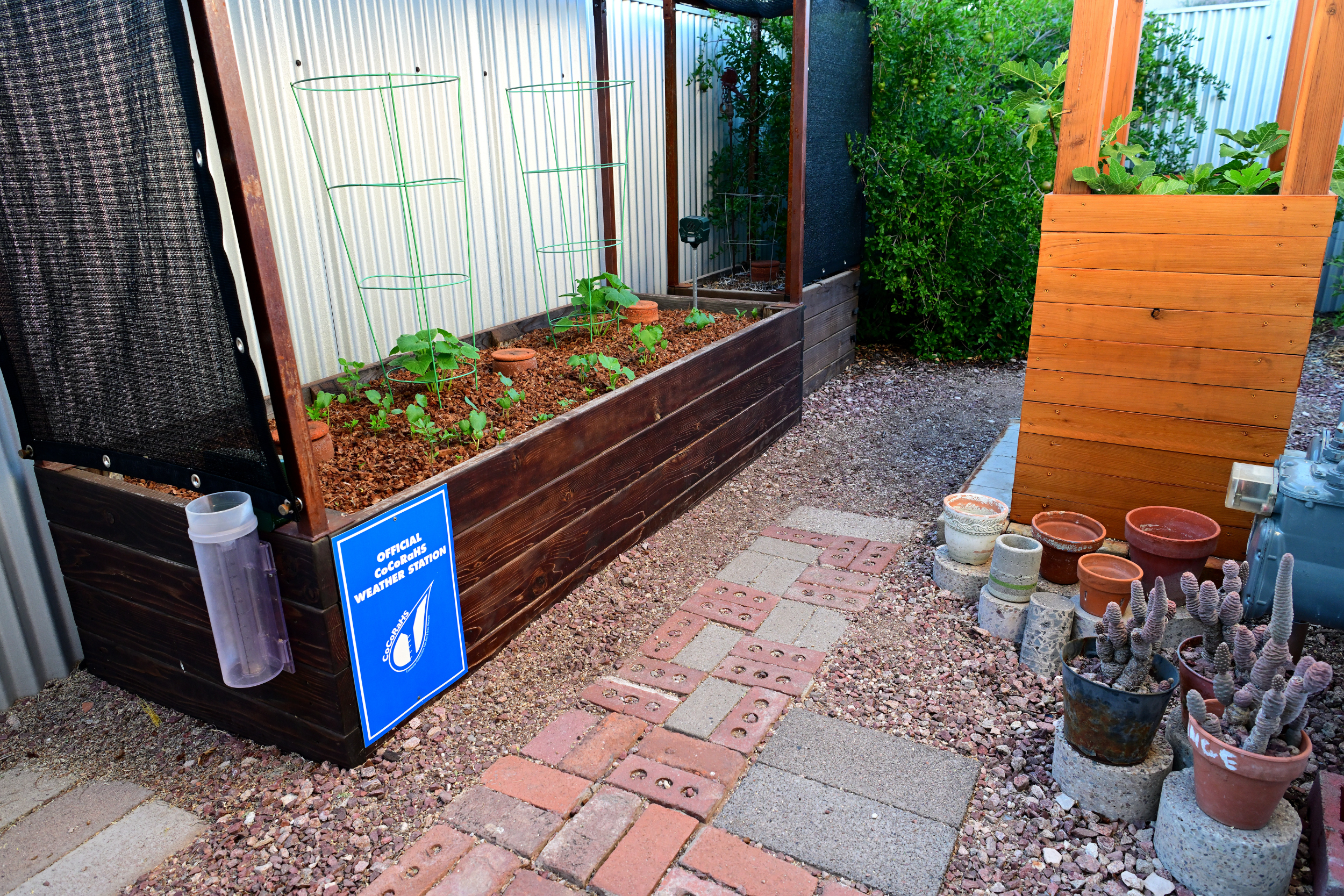
As for my big garden bed, it is going to town! (See above photo.) I planted cucumber seeds and they are really twining up their trellises.
And my hot pepper seeds, which are several years old, they’ve germinated and they are making a pretty good run for the roses! So to speak.
I’d also like to say something else about my big garden bed. I have to water it every single day or the plants will turn into a bunch of droopy drama queens.
I have a shade cloth above my big garden bed, and there’s another one on its south side. The two shade cloths keep those mean midday sun rays off the garden.
At this time of the year, an un-shaded garden gets toasty-toasty. When that happens, the garden dies.
I also have a Fignomenal dwarf fig tree in a raised-bed planter. I put some melon seeds in this planter and, well, they’ve germinated. And they’re growing, little by little.
What’s the problem here?
Truth be told, I don’t think those melon vines are getting enough sunlight. I’ve had to pull some of them out. The rest are just moseying along.
I’m thinking that as the summer progresses and the sun moves further north, the Fignomenal bed may get more sunlight and that could help the melon vines grow.
As for the Fignomenal, I just planted it last fall. Right now, it has a total of two figs. Since the Fignomenal is still developing its structure, I’m okay with such a small number.
Now, let’s go back to that little garden bed. As mentioned earlier, I made the executive decision to let it lay fallow.
For how long will I let that bed lay fallow?
To answer this question, let’s look at our summer monsoon forecast: We’re predicted to have above average rainfall, and we certainly hope so. We’ve been in a drought!
The monsoon season officially starts on June 15th, and I’m recording this episode on June 9th, so we’re just about there.
However, there are no signs of imminent rainfall. We may not have any rain until July, and that’s fairly normal.
But once those rains start, they may bring enough moisture to germinate the seeds in my little garden bed.
Or it may just continue to be a fallow bed until the late summer or early fall, when I plant snow pea seeds in it. In the past, this little garden bed has been a great producer of snow peas.
And that’s the Garden Gambler Report from Tucson.
If you’d like to learn more about water harvesting, sign up for my monthly email newsletter. If you do, I’ll give you a free copy of my Water Harvesting Cheat Sheet.
And if you’d like to support the Water Harvesting 101 podcast, the PayPal email address is info@westernskycommunications.com.
OUTRO: Thanks for listening to this episode of the Water Harvesting 101 podcast. If you’d like to learn more about water harvesting, meet my book family.
First, it’s City Nature, the book that’s guaranteed to look great on any coffee table. City Nature reveals my secrets to water harvesting through my 20-year journey of transforming my Tucson home into an urban oasis. Get the details at CityNatureBook.com.
And if you’re on the go, take water harvesting with you. Water Harvesting 101 is an audiobook and eBook combination that will teach you the nuts and bolts of water harvesting and show you how to put them to work. Available exclusively at WaterHarvesting101Book.com.