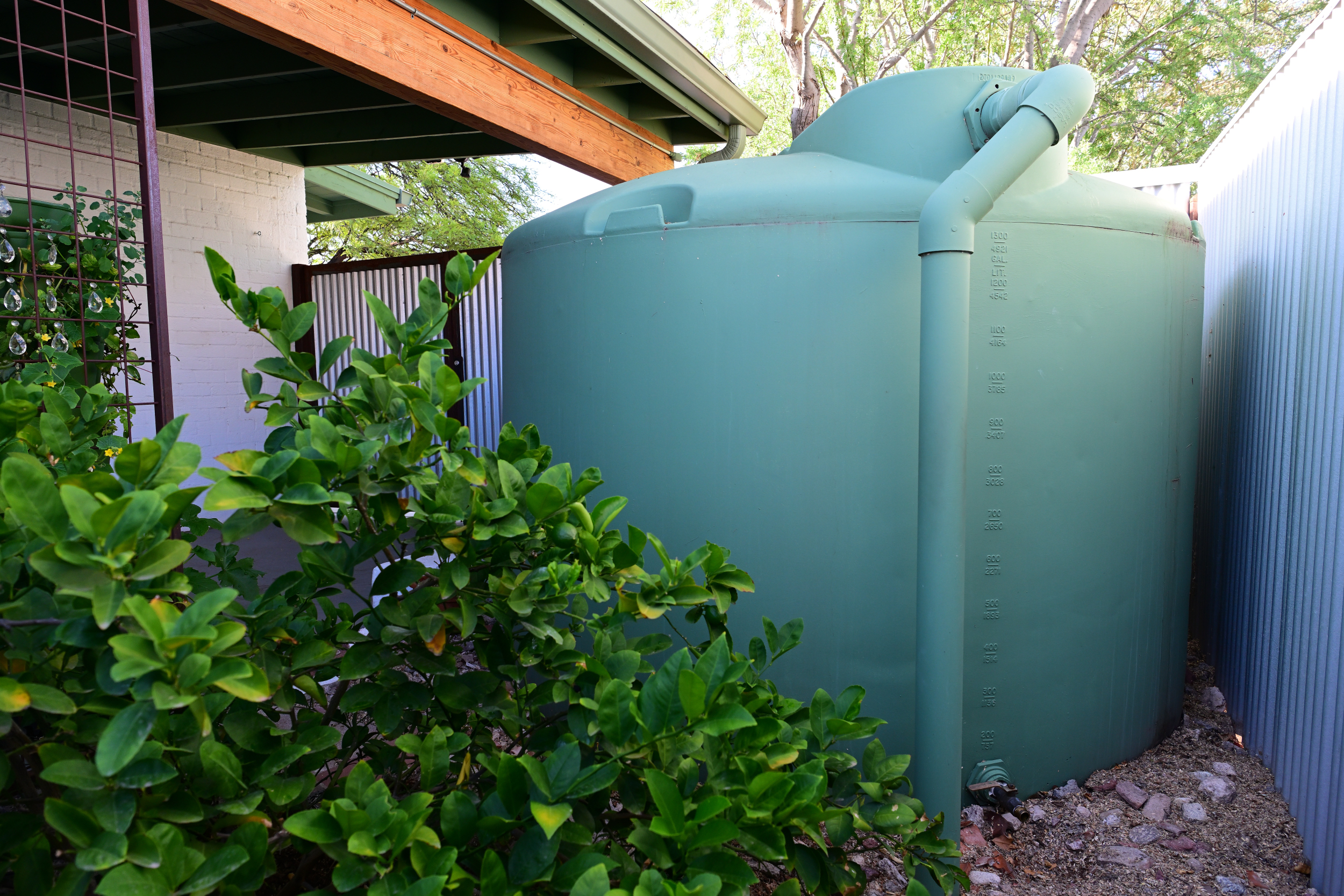
With the summer monsoon season starting on June 15 and running through September 30, it’s time to do the cistern math.
If your cistern is below capacity and you’re hoping for rainstorms to come and fill it, how much water will you need?
In this episode, I’ll walk you through the calculations.
Transcript
INTRO: From Tucson, Arizona, welcome to the Water Harvesting 101 podcast. My name is Martha Retallick. I’ve been a water harvester for 20 years, and I’m looking forward to helping you get started.
Before we do that, here’s a little Tucson secret: For most of the year, we’re in drought. That’s just how life is in the desert.
But when the rains return, oh, do they ever. They often bring an unwelcome friend called flooding.
How do we reduce the risks of flooding? We do it with water harvesting.
Water harvesting encompasses three activities:
- Redirecting rainwater away from where it isn’t wanted to where it is.
- Storing rainwater for later use, for example, during a drought.
- Recycling “used” water. At my place, I don’t let laundry water go down the drain. Instead, it’s for the fruit trees.
We’ll be covering all of these topics and more, so let’s get started.
EPISODE: It’s the sort of Monday morning that rainwater harvesters live for because…
It is raining!
It’s Monday, June 15th, the first day of monsoon season here in Tucson. It’s a season that stretches until September 30th , and, as mentioned in previous podcasts, we are predicted to have above average rainfall.
Today I would like to talk about my cistern, your cistern, everybody’s cistern, and how they relate to rainfall. Let’s do a little cistern math.
My cistern has the capacity for 1,500 gallons of storage. Right now, there are about 1,000 gallons in it. So, I’m about 500 gallons down.
I’ve been watering my gardens like crazy during the hot dry season – which I hope ended yesterday – and now we’re in the rainy monsoon season. So, I have 500 gallons that I need to get from the sky.
What does that figure mean in terms of rainfall? Let’s do the math.
First of all, this cistern is harvesting rainwater from 500 square feet of roof. That’s your first unit of measure.
Now, let’s roll in a one-inch rainstorm. We’re probably not going to get that much today, but hey, we can always hope.
A one-inch rainstorm on 500 square feet of roof is going to produce about 250 gallons. In order to fill my cistern back up to capacity, I need 500 gallons or two inches of rain. Like I said, not likely to happen today, but this is the summer monsoon season.
During the summer monsoons, Tucson gets an average of 5.69 inches.
This year, we are predicted to have above average rainfall. So it’s possible that we could get, say six inches of rain. So 500 gallons – and then some!
Of course, I’m going to keep using this cistern water during the summertime. I do have two raised beds that I’m watering right now, and a third that that’s laying fallow because things just weren’t sprouting in it.
Now that it’s monsoon season, I have some melon seeds that I may put in that little garden bed to see if they sprout.
If you’d like to learn more about water harvesting, sign up for my monthly email newsletter. If you do, I’ll give you a free copy of my Water Harvesting Cheat Sheet.
And if you’d like to support the Water Harvesting 101 podcast, the PayPal email address is info@westernskycommunications.com.
OUTRO: Thanks for listening to this episode of the Water Harvesting 101 podcast. If you’d like to learn more about water harvesting, meet my book family.
First, it’s City Nature, the book that’s guaranteed to look great on any coffee table. City Nature reveals my secrets to water harvesting through my 20-year journey of transforming my Tucson home into an urban oasis. Get the details at CityNatureBook.com.
And if you’re on the go, take water harvesting with you. Water Harvesting 101 is an audiobook and eBook combination that will teach you the nuts and bolts of water harvesting and show you how to put them to work. Available exclusively at WaterHarvesting101Book.com.