In the second episode of this two-part series, the focus is on rainwater harvesting cisterns.
You’ll learn how rain falling from the sky ends up in a cistern, what happens when a cistern overflows, and methods for getting water out of your cistern and onto your plants.
Note: This is the final episode of the audio-only podcast. Future episodes will be on YouTube at this link: https://www.youtube.com/@waterharvesting101
Transcript
INTRO: From Tucson, Arizona, welcome to the Water Harvesting 101 podcast. My name is Martha Retallick. I’ve been a water harvester for 20 years, and I’m looking forward to helping you get started.
Before we do that, here’s a little Tucson secret: For most of the year, we’re in drought. That’s just how life is in the desert.
But when the rains return, oh, do they ever. They often bring an unwelcome friend called flooding.
How do we reduce the risks of flooding? We do it with water harvesting.
Water harvesting encompasses three activities:
- Redirecting rainwater away from where it isn’t wanted to where it is.
- Storing rainwater for later use, for example, during a drought.
- Recycling “used” water. At my place, I don’t let laundry water go down the drain. Instead, it’s for the fruit trees.
We’ll be covering all of these topics and more, so let’s get started.
EPISODE: Welcome to the second episode in a two-part series on rainwater harvesting basics. Let’s talk about cisterns.
I’ve been using a cistern to store rainwater for six years. Got a 1,500 gallon tank in the backyard – that’s 5,678 liters.
Simply put, a cistern is a container for storing rainwater for later use. It can be above ground or below ground. Most of us choose above-ground cisterns because the installation costs are so much lower.
How does rain falling out of the sky get into a cistern? First stop on its journey is your roof, where it rolls downhill into rain gutters.
And then it rolls into a rain head, which is a screen-covered device below your downspout. And, yes, that rain head will keep catching water after the rain stops.
The rain head’s job is to keep sticks, twigs, leaves, and other crud from getting into your cistern water. It’s also a good idea to have screens over your rain gutters.
A brief note on screen hygiene: I recommend that you have your rain gutters and screens cleaned twice a year, say, in May and November.
If rooftop adventures aren’t your thing, hire a professional cleaning crew for those rain gutters and screens.
As for cleaning your rain head, that’s the perfect DIY job. Soapy water and a tooth brush work just fine.
Let’s get back to our downhill-flowing rainwater. It’s going through above- and below-ground plumbing pipes that terminate at the cistern.
What happens when a cistern gets all filled up? Where does the excess water go?
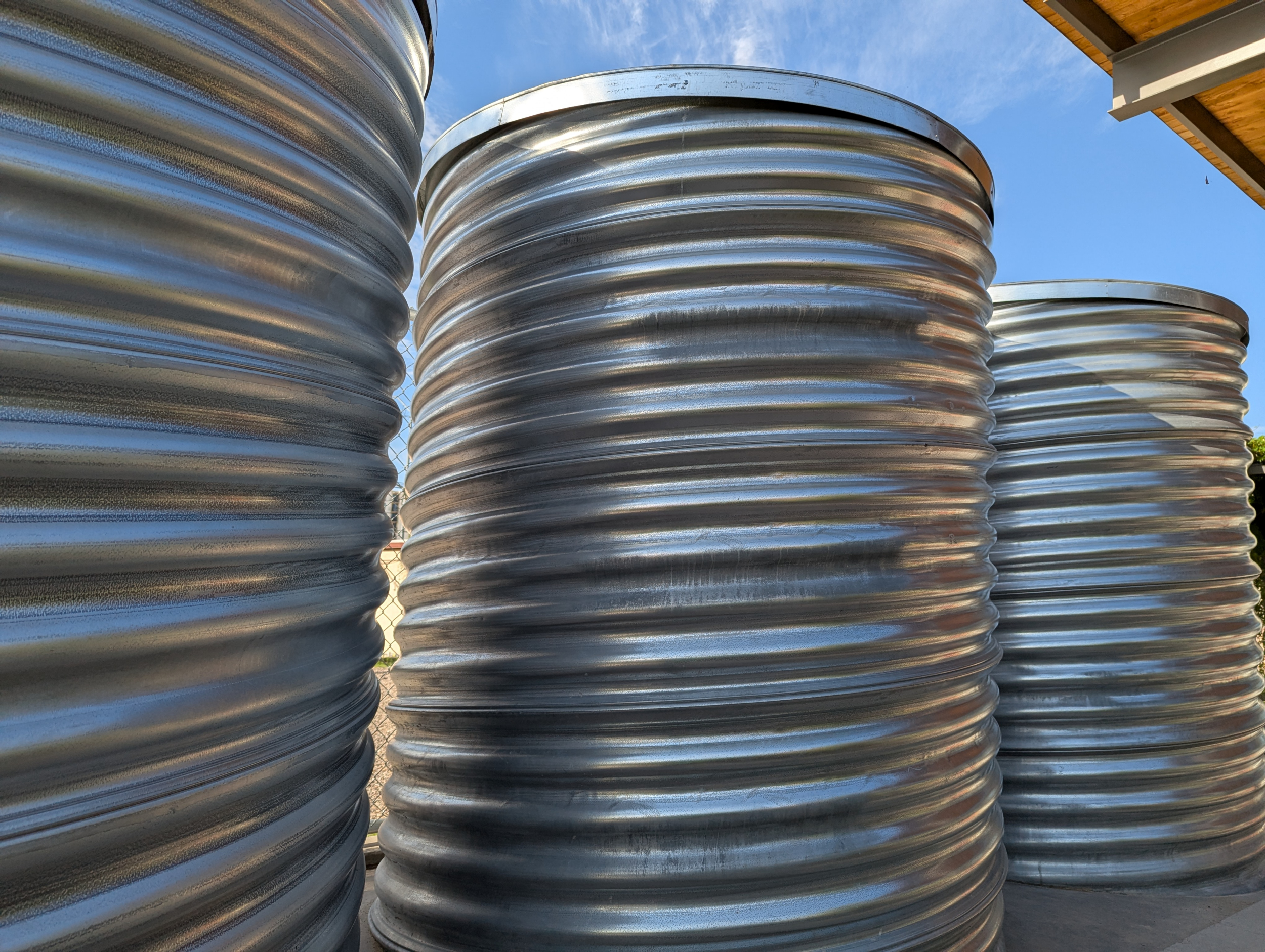
It can go into additional cisterns, and that’s how it’s done at the Food Conspiracy Co-op in Tucson. (See above photo.)
At my place, there is overflow plumbing that leads away from the cistern and ends at an outlet.
That outlet has a little white flapper valve that is opened by water pressure. Once the water flows past the flapper valve, it goes into a little overflow basin in my backyard. Right now, my cistern is completely full, so that overflow basin is busy.
Next question you might have about a cistern: It’s great to store water, but what if you want to use it? How do you get the water out of the cistern and onto your plants?
Well, some people use irrigation pumping systems. Me, I’m frugal. I prefer not to spend the money on that sort of thing.
Around here, I’m using a rusty old watering can or an orange bucket from a well-know home improvement store.
I don’t use a garden hose to get the water out of the cistern. Since my cistern is a gravity flow system, that would take forever.
Instead, I use a laundry supply hose. This is a short hose, just like the one you use on the back of your washing machine. One end is connected to the cistern and the other end goes into a watering can.
When the can is full, I take it over to my raised bed garden.
Same thing with the bucket. When the bucket is as full as I want it to be, I carry it my two pomegranate trees and the dwarf fig tree.
If you’d like to learn more about water harvesting, sign up for my monthly email newsletter. If you do, I’ll give you a free copy of my Water Harvesting Cheat Sheet.
And if you’d like to support the Water Harvesting 101 podcast, here’s the Tip Jar!
OUTRO: Thanks for listening to this episode of the Water Harvesting 101 podcast. If you’d like to learn more about water harvesting, meet my book family.
First, it’s City Nature, the book that’s guaranteed to look great on any coffee table. City Nature reveals my secrets to water harvesting through my 20-year journey of transforming my Tucson home into an urban oasis. Get the details at CityNatureBook.com.
And if you’re on the go, take water harvesting with you. Water Harvesting 101 is an audiobook and eBook combination that will teach you the nuts and bolts of water harvesting and show you how to put them to work. Available exclusively at WaterHarvesting101Book.com.