In this episode, we’ll be looking at rainwater harvesting earthworks.
These are human-built features that blend into your landscape, and they facilitate the absorption of rainwater into the earth.
Give this one a listen and learn what swales, basins, and berms can do for you.
Transcript
INTRO: From Tucson, Arizona, welcome to the Water Harvesting 101 podcast. My name is Martha Retallick. I’ve been a water harvester for 20 years, and I’m looking forward to helping you get started.
Before we do that, here’s a little Tucson secret: For most of the year, we’re in drought. That’s just how life is in the desert.
But when the rains return, oh, do they ever. They often bring an unwelcome friend called flooding.
How do we reduce the risks of flooding? We do it with water harvesting.
Water harvesting encompasses three activities:
- Redirecting rainwater away from where it isn’t wanted to where it is.
- Storing rainwater for later use, for example, during a drought.
- Recycling “used” water. At my place, I don’t let laundry water go down the drain. Instead, it’s for the fruit trees.
We’ll be covering all of these topics and more, so let’s get started.
EPISODE: When water harvesters talk about rainwater harvesting, what do we mean?
In this episode, we’ll be looking at rainwater harvesting using earthworks.
I’ve been using earthworks in my yard for nearly 20 years. Let’s see how they work.
In a rainwater harvesting earthworks system, the action starts above us. It starts when rainwater strikes the roof, flows into rain gutters and downspouts, and then it meets the first feature in the earthworks.
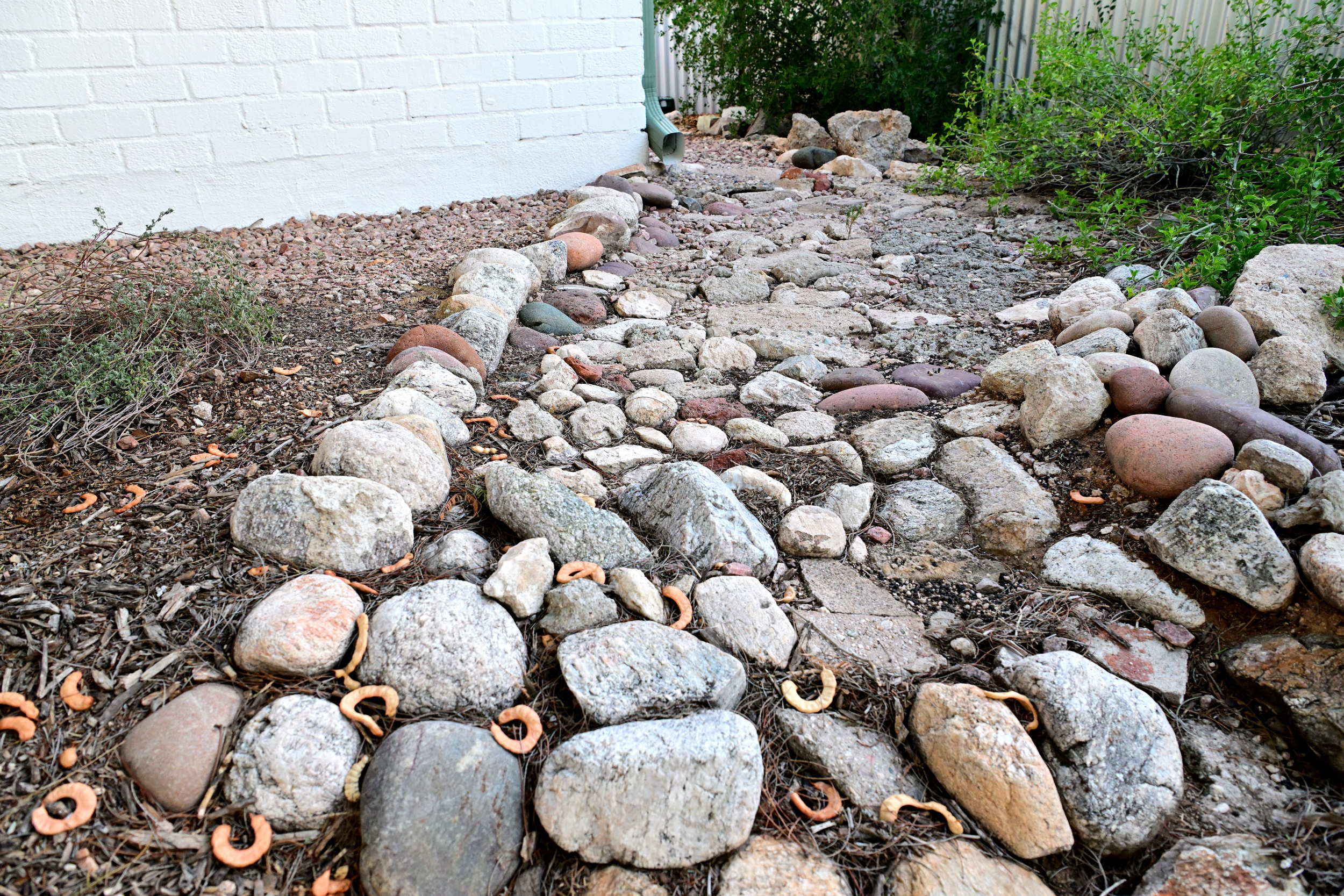
That would be the drainage swale. (See above photo.)
The drainage swale is lined with various hard objects like rocks, pieces of cement, bricks, even logs. Whatever you find, it’s fair game.
We build these hard objects into the swale so that the rainwater has something to run into. And all of these little collisions reduce the velocity of the water as it flows downhill.
Where’s that water going? It’s flowing into the second feature in the earthworks, the rainwater harvesting basin.
A basin is like a little pond in your yard. It’s a place that encourages rainwater to sink into the ground gradually.
We put mulch in the bottom of our basins because we want to give that rainwater something to soak into. We don’t want it to form pools that get lost to evaporation.
Instead, our mulch is creating a blanket that absorbs the water as it spreads out and sinks into the ground. And, fun fact, as the basin fills with water, mulch floats!
Now, here’s the good part: Water that sinks into the ground nourishes the plant life and it replenishes the water table. Those are two big wins!
Let’s look at the third and final feature in the earthworks. That would be the berm.
The berm is like an earthen dam. Or think of it as a great big hug around your yard that keeps the rainwater on your property – and out of the street – where it could cause flooding.
Where do rainwater harvesting earthworks come from? They come from our mother, Mother Nature!
Swales? Think intermittently flowing rocky stream.
Basins are also quite common in nature. They can be formed by low spots in the ground or in rocks.
Berms? They’re all over the place!
For example, if you’re ever driving down the road and you notice that the road is higher than the surrounding landscape, the road is acting as a berm to drain water so the road doesn’t flood.
In summary, here’s what we’re doing with rainwater harvesting earthworks: We’re recreating what is already found in nature.
If you’d like to learn more about water harvesting, sign up for my monthly email newsletter. If you do, I’ll give you a free copy of my Water Harvesting Cheat Sheet.
And if you’d like to support the Water Harvesting 101 podcast, here’s the Tip Jar!
OUTRO: Thanks for listening to this episode of the Water Harvesting 101 podcast. If you’d like to learn more about water harvesting, meet my book family.
First, it’s City Nature, the book that’s guaranteed to look great on any coffee table. City Nature reveals my secrets to water harvesting through my 20-year journey of transforming my Tucson home into an urban oasis. Get the details at CityNatureBook.com.
And if you’re on the go, take water harvesting with you. Water Harvesting 101 is an audiobook and eBook combination that will teach you the nuts and bolts of water harvesting and show you how to put them to work. Available exclusively at WaterHarvesting101Book.com.