This is an episode devoted to an organic superstar – mulch!
Organic mulch comes to us as wood chips, bark, and leaves, and it’s derived from carbon-based life forms like trees and shrubs.
I’ll talk about the wonderful things that mulch can do for your yard, and explain how you can get mulch.
Note: This episode includes a special guest appearance by a wood chipper.
Transcript
INTRO: From Tucson, Arizona, welcome to the Water Harvesting 101 podcast. My name is Martha Retallick. I’ve been a water harvester for 20 years, and I’m looking forward to helping you get started.
Before we do that, here’s a little Tucson secret: For most of the year, we’re in drought. That’s just how life is in the desert.
But when the rains return, oh, do they ever. They often bring an unwelcome friend called flooding.
How do we reduce the risks of flooding? We do it with water harvesting.
Water harvesting encompasses three activities:
- Redirecting rainwater away from where it isn’t wanted to where it is.
- Storing rainwater for later use, for example, during a drought.
- Recycling “used” water. At my place, I don’t let laundry water go down the drain. Instead, it’s for the fruit trees.
We’ll be covering all of these topics and more, so let’s get started.
EPISODE: Just got another bill from Tucson Water. It was pretty reasonable. I paid it.
Also included in the mailing was the Tucson Water newsletter, Water Matters.
This is a pretty good little newsletter, and I want to call your attention to an article that ran in the latest issue, “Happy Roots Start With Mulch.”
And here’s my meditation on mulch.
What I’m referring to is organic mulch, which comes from carbon-based life forms like trees and shrubs, and it breaks down into wood chips, bark, leaves, etc.
Here in the desert, we like mulch, and this is why:
First of all, during this past weekend, we had some of that stuff that falls from the sky. I’m talking about R-A-I-N.
Having a layer of mulch on your soil creates a protective layer that helps retain the moisture-from-above by reducing evaporation.
Now, mind you, this storm we just had, it was only five hundredths of an inch. Whoopee!
But more is on the way. We’re predicted to have an above-average monsoon rainfall season. It may start very soon.
Second, we like mulch for soil temperature regulation. It acts like a cooling blanket that keeps the soil from heating up like an oven. In the summertime, that’s important. It also keeps the soil cool at night.
We like mulch for new plants because it helps them get a good start. Speaking of new plants, I use mulch in my container gardens. I have two container plants growing right now.
One container holds a hot pepper plant. I’m mulching that container with ironwood tree leaves that have fallen onto my cistern. I sweep those leaves off – or scoop them into my hand – and then they go into this little container.
In my backyard, I’m using tree and bark mulch for a potted Texas Ranger shrub. I planted this shrub in the wrong part of my yard, and it’s spending the summer in a pot. I’m going to replant it in a cooler spot this fall.
Here’s the third reason why we like mulch, and it’s a long-term benefit. It improves soil health as it breaks down.
The mulch provides organic material that enriches the soil, enhances its structure, and its ability to retain moisture. The technical term for this is improving the soil food web.
The fourth reason is why I started using mulch in the first place. Twenty-two years ago, when I bought this house, I had a weed problem. I was told that if I put mulch down, those weeds would go away.
Know what? Over time, that has become very true.
I seldom have a weed around here. In fact, I’m shocked when I do have weeds.
Now, where do you get mulch? First, you can go to the home center or a garden store and buy it in bags. I recently podcasted about a local company, Tanks Green Stuff, that sells it that way.
Second, you can have mulch delivered to you in a big truck. Again, Tanks Green Stuff will deliver it to you.
Third, there’s the noisy way. Here comes the wood chipper!
[sound of wood chipper]
Thank you, wood chipper.
I just had my trees trimmed by Romeo Tree Service, a Tucson company. After they were finished with the trimming – which was accomplished with hand tools – they fired up the wood chipper, ground everything up, and then they dumped a pile in my driveway.
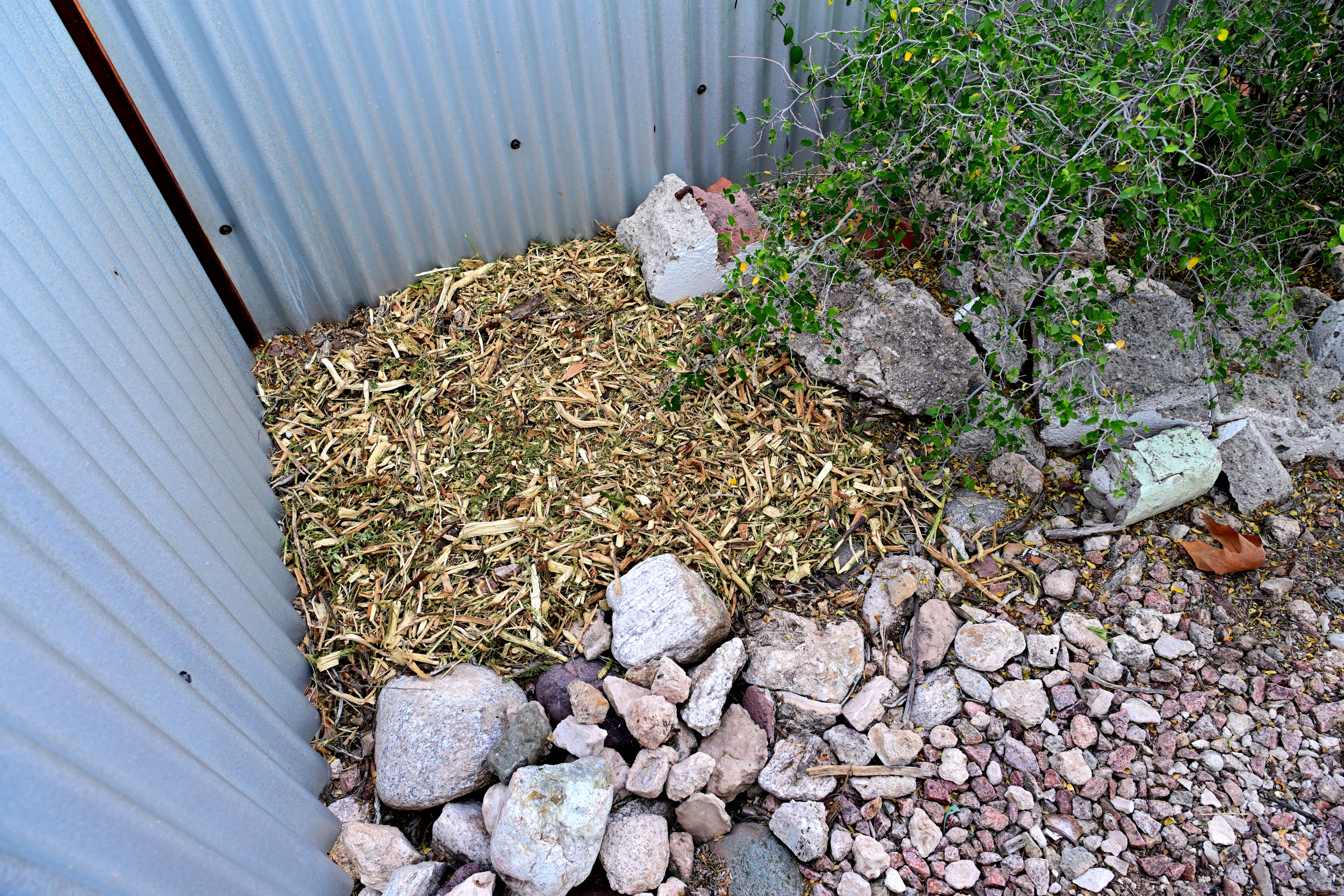
It wasn’t a big pile. It was only, let’s say, about the capacity of two bathtubs. And I only needed an hour to spread it around the yard with my almighty five-gallon bucket.
I didn’t have enough for the whole yard, so I put the mulch in places where it was needed. (See above photo.)
And now, the fourth way to get mulch. It happens over time. During the cool times of the year, fall and winter, your trees and shrubs drop leaves.
Instead of raking my leaves and throwing them away, I let them stay in the yard so they can become… mulch!
And that’s my meditation on mulch.
If you’d like to learn more about water harvesting, sign up for my monthly email newsletter. If you do, I’ll give you a free copy of my Water Harvesting Cheat Sheet.
And if you’d like to support the Water Harvesting 101 podcast, the PayPal email address is info@westernskycommunications.com.
OUTRO: Thanks for listening to this episode of the Water Harvesting 101 podcast. If you’d like to learn more about water harvesting, meet my book family.
First, it’s City Nature, the book that’s guaranteed to look great on any coffee table. City Nature reveals my secrets to water harvesting through my 20-year journey of transforming my Tucson home into an urban oasis. Get the details at CityNatureBook.com.
And if you’re on the go, take water harvesting with you. Water Harvesting 101 is an audiobook and eBook combination that will teach you the nuts and bolts of water harvesting and show you how to put them to work. Available exclusively at WaterHarvesting101Book.com.